November 23, 2026 · 8 min read
150 Lea Linen Explained: Linen Yarn Count (Lea, Nm, Ne) and GSM Conversion Guide
What 150 lea linen means, how to convert lea to tex, Nm and Ne, how yarn count and thread density decide GSM, and how to compare linen counts with a Sample Kit before you order.
Quick answer
Lea is a linen yarn count: the higher the number, the finer the yarn. 150 lea is a very fine yarn (about 11.0 tex or 90.7 Nm) that usually weaves into light linen of roughly 70–100 GSM. Lea alone does not fix the weight — thread density and finishing do too — so compare finished swatches before you order.
Key takeaways
- Lea = number of 300-yard hanks per pound of yarn; higher lea = finer yarn.
- 150 lea ≈ 11.0 tex ≈ 90.7 Nm ≈ 53.6 Ne.
- GSM depends on yarn count × threads per cm, plus crimp and finishing.
- The same count can be woven at very different weights — check GSM, not count alone.
- Ask which count system an 'S' label uses before comparing quotes.
- Compare counts in hand with a Sample Kit, then lock count, GSM and width in the tech pack.
Why buyers search for "150 lea linen"
Lea counts appear on linen quotes from India, Europe and many trading companies, while GSM appears on most spec sheets and tech packs. When a supplier offers "150 lea linen" and your designer asks for "90 GSM", you need to know how the two relate. This guide gives you the conversions, a quick weight estimate, and a way to check it in hand.
What "lea" means
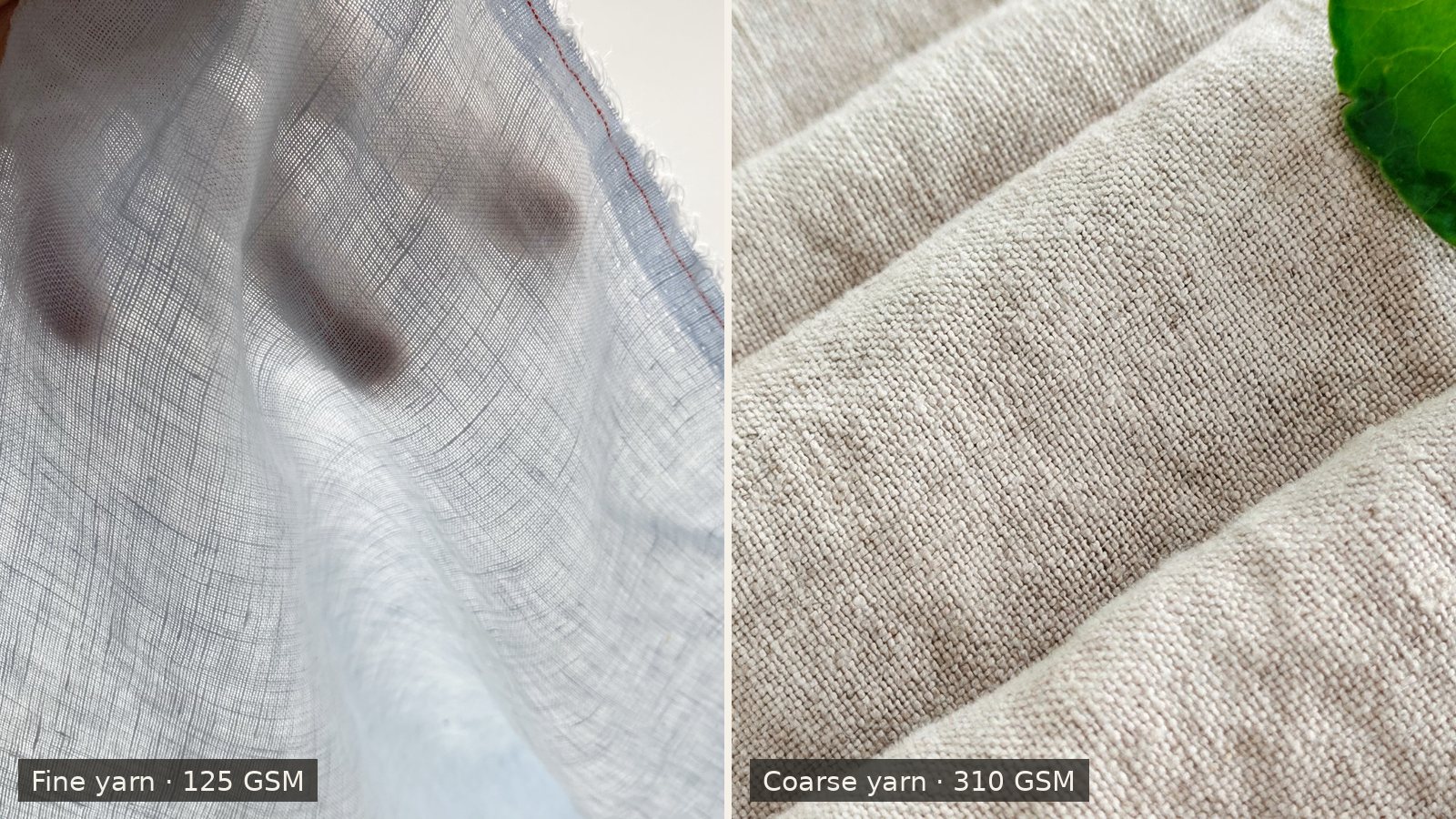
Lea is the traditional linen yarn count. It is the number of 300-yard hanks ("leas") of yarn that weigh one pound. A higher lea number means a thinner, finer yarn. A 150 lea yarn is ten times finer than a 15 lea yarn of the same weight per length.
Other systems describe the same yarn differently:
- tex — grams per 1,000 metres (a direct system: higher = heavier yarn). tex = 1653.5 ÷ lea.
- Nm (metric count) — metres per gram. Nm = lea × 0.6048.
- Ne (English cotton count) — 840-yard hanks per pound. Ne = lea ÷ 2.8.
Lea conversion table
| Lea | tex | Nm (metric) | Ne (English cotton count) |
|---|---|---|---|
| 14 | 118.1 | 8.5 | 5.0 |
| 25 | 66.1 | 15.1 | 8.9 |
| 40 | 41.3 | 24.2 | 14.3 |
| 60 | 27.6 | 36.3 | 21.4 |
| 100 | 16.5 | 60.5 | 35.7 |
| 150 | 11.0 | 90.7 | 53.6 |
A quick check: 150 lea ≈ 53.6 Ne, so it is a similar fineness to a 54s cotton shirting yarn.
Does a lea count tell you the GSM?
Not on its own. GSM (grams per square metre) depends on two things: how heavy each yarn is, and how many yarns are packed into each centimetre. You can estimate it:
GSM ≈ (ends per cm × warp tex + picks per cm × weft tex) ÷ 10, then add about 5–10% for yarn crimp (the extra length as yarn bends over and under).
Two illustrative examples (example densities, not a mill specification):
- 150 lea × 150 lea (11.0 tex) at 36 ends × 34 picks per cm ≈ 82 GSM.
- 40 lea × 40 lea (41.3 tex) at 20 ends × 19 picks per cm ≈ 172 GSM.
Public wholesale listings for 150 lea linen commonly quote roughly 70–100 GSM. Washing and finishing then change the weight again — our linen GSM chart explains how much and which weight suits each product.
Same count, different weights: real examples
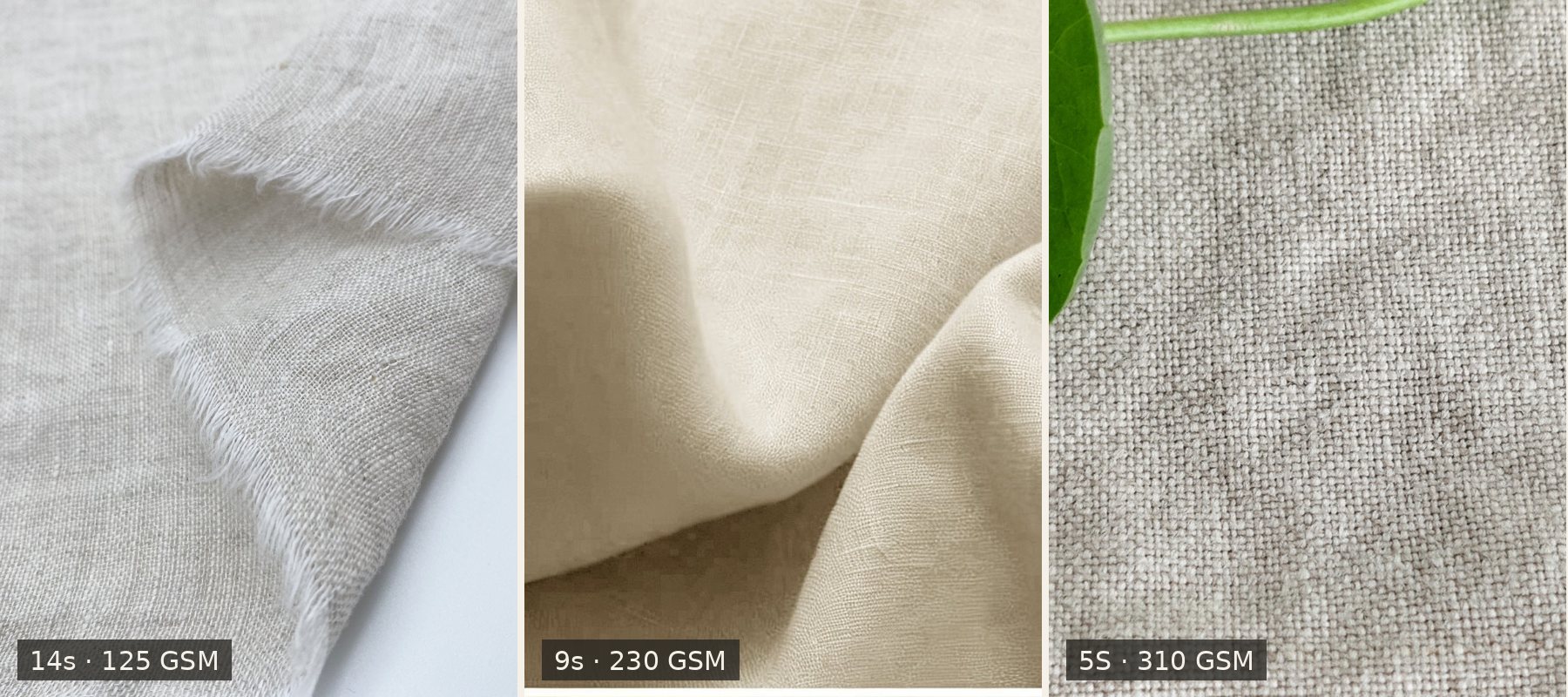
These pure linens are in our fabric library. The count is shown exactly as the supplier labels it. Notice that three "14" fabrics range from 125 to 180 GSM — density and finishing matter as much as count.
| Fabric | Labelled count | GSM | Width |
|---|---|---|---|
| 14s Lightweight Sand-Washed Pure Linen | 14s | 125 | 138 cm |
| Wide Washed French Linen | 14-count | 160 | 290 cm |
| Natural French Linen, Extra Wide | 14s | 180 | 300 cm |
| Washed Heavyweight Linen | 9s | 230 | 290 cm |
| Heavyweight French Dew-Retted Linen | 5S | 310 | 200 cm |
Watch the letter "S"
Many mills write linen counts with an "S" — 14S, 21S, 36S. That letter does not say which system is used. Before you compare a quote in "S" with one in lea, ask the supplier whether the number is lea, metric (Nm) or English cotton count (Ne). Mixing them up can mean a yarn that is two to three times coarser or finer than you expected.
What 150 lea linen is good for
- Good fit: lightweight summer shirts, blouses, kidswear, scarves, pocket squares, handkerchiefs and sheer curtains.
- Plan for it: at light weights linen is semi-sheer in pale colours, so dresses and trousers may need a lining or a darker shade.
- Usually not right: relaxed trousers, jackets, bedding and table linen, which need more body — see our linen weights and weaves guide.
How to spec yarn count on your order
Write one line that a mill or workshop cannot misread, for example: "100% linen, plain weave, 150 lea × 150 lea, target 90 GSM after wash, 145 cm usable width, pre-shrunk." Then approve the GSM and shrinkage on a finished swatch — our linen shrinkage guide and tech pack checklist show what else to include.
If your brief calls for 150 lea, send the target GSM, width, colour and quantity. We check availability with our partner fabric mills and confirm the finished GSM on a swatch before quoting.
Compare counts in hand with a Sample Kit
Numbers get you close; your hand decides. Request a Sample Kit and tell us the counts or weights you are considering — for example a fine shirting next to a mid-weight — so you can compare opacity, hand and drape side by side before sampling.
Order sizes
LinenTailor runs a cut-and-sew workshop in Dongguan, China, with fabrics sourced from trusted linen mills; OEKO-TEX Standard 100 certified linen is available on request. Custom apparel starts from 30 pieces per colour per style with mixed sizes, and custom home textiles from 1 piece. Sampling is quoted separately and the sample fee is credited back once a style reaches 150 bulk pieces. Send your fabric brief on WhatsApp for a quote within 24 hours. Orders ship by worldwide express shipping.
Frequently asked questions
- What does 150 lea mean in linen?
- Lea is the traditional linen yarn count: the number of 300-yard hanks of yarn that weigh one pound. A higher number means a finer yarn. 150 lea is a very fine linen yarn — about 11.0 tex, 90.7 Nm or 53.6 Ne — used for light, smooth shirting and handkerchief-type linen.
- What GSM is 150 lea linen?
- There is no fixed GSM for a lea count, because weight also depends on how many threads are woven per centimetre and on finishing. Public wholesale listings for 150 lea linen commonly quote roughly 70–100 GSM. Always confirm the finished GSM on a swatch.
- How do I convert lea to tex, Nm or Ne?
- tex = 1653.5 ÷ lea; Nm = lea × 0.6048; Ne (English cotton count) = lea ÷ 2.8. For example 60 lea ≈ 27.6 tex, 36.3 Nm or 21.4 Ne.
- Can I calculate fabric GSM from the lea count?
- Only as an estimate. Convert lea to tex, then GSM ≈ (ends per cm × warp tex + picks per cm × weft tex) ÷ 10, plus about 5–10% for yarn crimp. Washing and finishing change the result, so approve the GSM on a finished sample.
- Is higher lea linen always better quality?
- No. Higher lea means finer yarn, which gives a lighter, smoother and usually more expensive cloth. Quality also depends on fibre length, yarn evenness, weave density and finishing. A coarse, heavy linen can be the right high-quality choice for trousers, bedding or curtains.
- Can LinenTailor supply 150 lea linen?
- Send your target GSM, width, colour and quantity. We check availability with our partner fabric mills and confirm the finished GSM on a swatch before quoting.
- How can I compare linen counts before ordering?
- Request a Sample Kit with the counts and weights you are considering, and compare opacity, hand and drape side by side. Then write the count, GSM, width and finish on your tech pack.