
September 22, 2026 · 11 min read
Linen Shrinkage: Real Rates, Pre-Shrinking Methods and How to Spec It
How much linen actually shrinks, why it happens, and how pre-shrinking, sanforizing, garment washing and pattern allowance keep sizes stable in production. A practical spec guide for designers and boutique brands.
Quick answer
Untreated woven linen shrinks about 3–7% after the first hot wash (up to 10% for loose or heavy weaves). Pre-shrunk or sanforized linen keeps residual shrinkage to roughly 1–3%, and garment washing after sewing gives the most stable finished measurements.
Key takeaways
- Untreated woven linen typically shrinks 3–7% after the first wash; loose or heavy weaves can reach 10%.
- Most shrinkage is relaxation of tension added during weaving and finishing, plus fibre swelling — it is not a defect.
- Pre-shrinking (compressive shrinking / sanforizing) before cutting reduces residual shrinkage to roughly 1–3%.
- Garment washing after sewing gives the most stable result and a soft, lived-in hand, but the pattern must be cut oversized.
- Always specify the wash method, the acceptable residual shrinkage and the measurement point — after wash, not before.
- LinenTailor pre-shrinks fabric and adds shrinkage allowance at the pattern stage for apparel from 30 pieces per colour and home textiles from 1 piece.
Shrinkage is the single most common reason a linen order goes wrong. The sample fits, the bulk arrives, the customer washes it once — and the shirt is now a size smaller. Nothing was defective. The fabric simply did what flax always does, and nobody wrote it into the specification.
This guide covers the real numbers, the physics behind them, the treatments that control shrinkage, and the exact lines you should put in a spec sheet so the garment you approve is the garment your customer keeps.
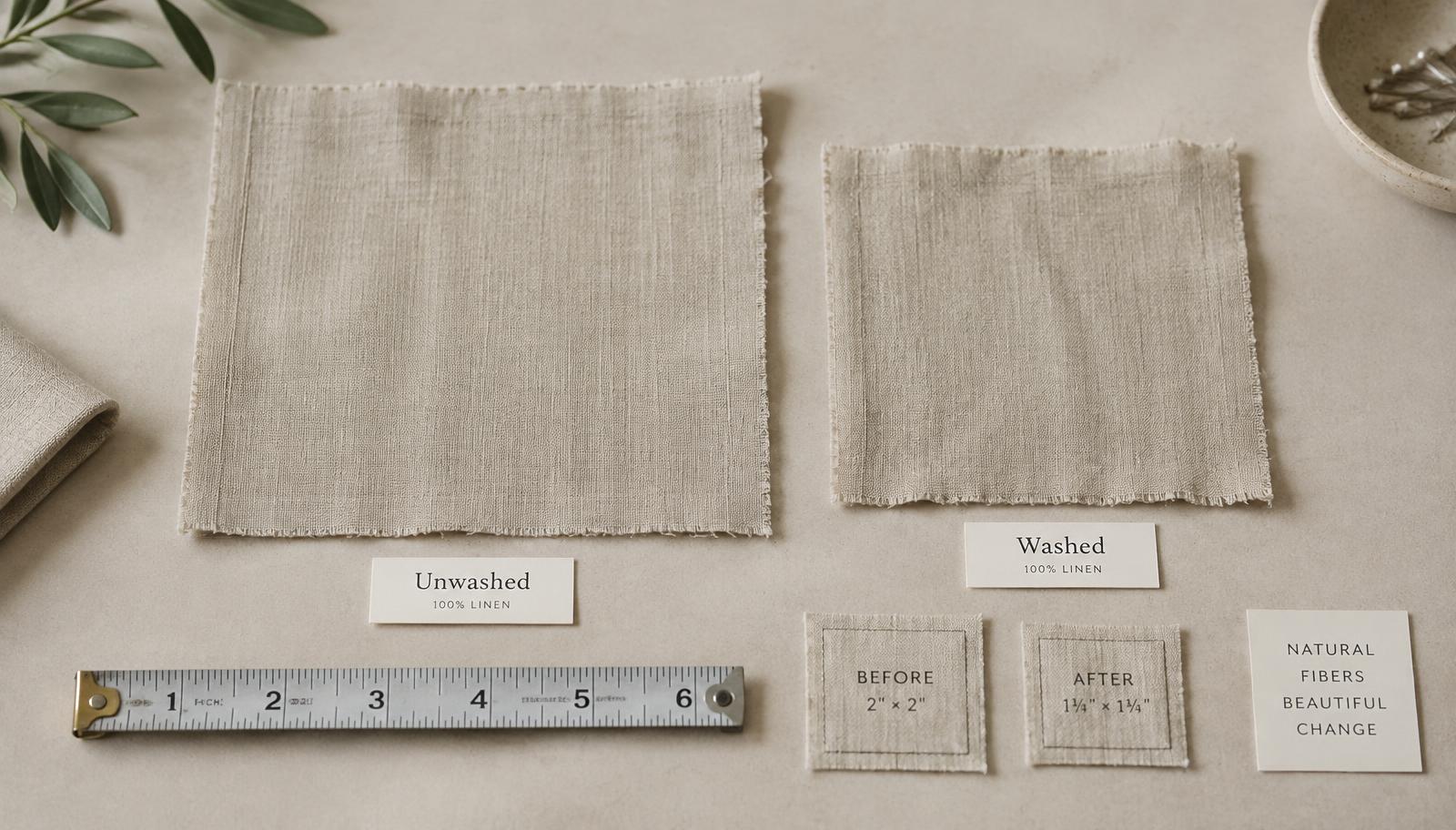
How much linen actually shrinks
These are the ranges we measure in our own mill on a 40°C machine wash with low tumble drying. Air drying flat typically lands 1–2 points lower.
| Construction | Untreated | Pre-shrunk |
|---|---|---|
| Lightweight plain weave (110–150 GSM) | 3–5% | 1–2% |
| Mid-weight plain / twill (160–220 GSM) | 4–6% | 1.5–3% |
| Heavyweight (240–320 GSM) | 5–8% | 2–3% |
| Loose weave / gauze / double gauze | 7–10% | 3–4% |
| Cotton-linen blend | 3–5% | 1–2% |
| Linen-viscose blend | 4–7% | 2–3% |
| Linen knit / jersey | 5–8% (mostly length) | 2–4% |
Shrinkage is almost always higher in the length (warp) direction than across the width. On a shirt that shows up as a shorter body and sleeve before it shows up as a tighter chest.
Why it happens
1. Released tension
Warp yarns are held under heavy tension throughout weaving and finishing. The cloth leaves the mill slightly stretched. The first hot wash relaxes it, and the yarn returns toward its natural length. This is the largest share of total shrinkage.
2. Fibre swelling
Flax absorbs up to 20% of its weight in moisture. Wet fibres swell across their width, so the yarn takes a more crimped path through the weave and the fabric contracts. Once dry, the crimp stays.
3. Heat and agitation
Hot water and tumble drying accelerate both effects. The same fabric washed cold and line-dried can shrink half as much as one washed hot and tumbled.
4. Finishing and dyeing
Enzyme washing, stonewashing and garment dyeing all involve heat and agitation, so they consume part of the shrinkage before the customer ever sees the garment — which is exactly why washed-linen styles are dimensionally stable.
The four ways to control it
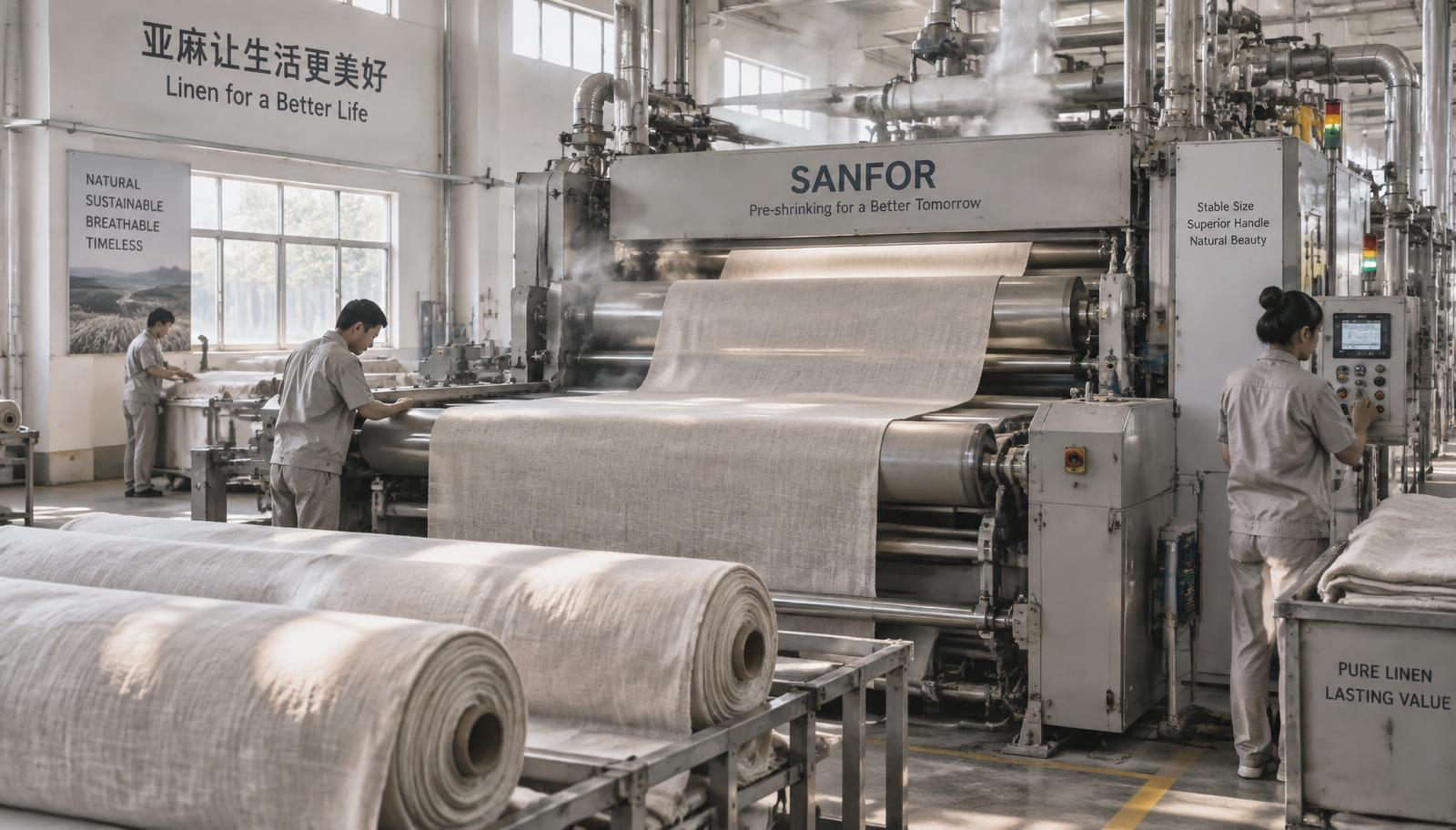
Pre-shrinking (compressive shrinking / sanforizing)
Fabric is steamed or wetted, then fed between a rubber belt and a heated cylinder that physically compresses it in the length direction before cutting. Residual shrinkage typically drops to 1–3%. This is the default for tailored shirts, blazers, trousers and anything with a strict measurement chart.
Relaxation / rinse pre-wash
The whole roll is washed and dried before cutting. Slower and more expensive per metre than compressive shrinking, but it removes the most tension and also softens the hand. Common for washed-linen bedding and soft-drape dresses.
Garment washing after sewing
The finished garment is washed — plain, enzyme or stone. It shrinks in a controlled, uniform way, comes out soft with the crinkled linen character buyers expect, and rarely moves again. The trade-off: the pattern must be cut 4–8% oversized, and small size deviations are normal.
Pattern shrinkage allowance
Whatever the treatment, the pattern maker adds an allowance per direction based on a washed test swatch. This is the step brands most often assume is happening automatically. Ask for it explicitly.
How to test shrinkage properly
- Cut a 50 × 50 cm swatch from the actual production roll, not a sample book.
- Mark a 40 × 40 cm square inside it with permanent thread or fabric marker.
- Wash it exactly as your care label will instruct, and dry it the same way.
- Measure the marked square again. Shrinkage % = (40 − new measurement) ÷ 40 × 100.
- Repeat the wash twice more. Cumulative shrinkage after three washes is the number that matters — most of the remaining movement appears in wash two.
Run the test in both directions and record them separately. A fabric that shrinks 5% in length and 1.5% in width is completely normal and needs two different allowances.
What to write in the spec sheet
Three lines prevent nearly every shrinkage dispute:
- Wash standard: "40°C machine wash, tumble dry low" (or your actual care label).
- Tolerance: "Maximum residual shrinkage 3% length / 2% width after three washes."
- Measurement basis: "All measurements in the size chart apply after washing."
That last line is the one that gets left out. If the factory measures before washing and you measure after, you will disagree by exactly the shrinkage rate.
Home textiles need more allowance, not less
Bedding is the least forgiving product category, because a fitted sheet either fits the mattress or it does not. We cut duvet covers, flat sheets and pillowcases oversized against the finished dimension and garment-wash them, so the labelled size is the post-wash size. If you are specifying linen bedding, always ask whether the stated dimensions are pre-wash or post-wash — the difference can be 5 cm on a duvet cover edge. Our home textiles start from a single piece, so a dimensional test run costs very little.
Shrinkage is not a quality problem — untracked shrinkage is
A linen that shrinks 5% and is specified, tested and allowed for produces a garment that fits after the first wash and stays that way for years. A linen that shrinks 5% and was never tested produces a return. The fibre behaves the same in both cases; only the paperwork differs.
For more on how weight and weave influence this, see our linen GSM chart and the weights and weaves guide. If you are about to sample, the sampling process and cost guide shows where the washed test fits into the timeline, and linen care covers what to put on the label.
Want the shrinkage rate for a specific quality? Request swatches from our fabric library and run the test yourself, or send us your style and target measurements — we pre-shrink before cutting, add the allowance at pattern stage and confirm the rate on a washed sample before bulk. Apparel from 30 pieces per colour, home textiles from 1 piece, quoted within 24 hours.
Frequently asked questions
- How much does linen shrink?
- Untreated woven linen usually shrinks 3–7% after the first hot wash and tumble dry. Lightweight tight weaves sit at the low end, while loose, heavy or gauze constructions can reach 8–10%. Pre-shrunk linen typically has 1–3% residual shrinkage.
- Why does linen shrink more than cotton?
- Flax fibre absorbs a lot of moisture and swells across its width, and linen yarn is woven under high tension. Heat and water release that tension and the yarn contracts, mostly in the length direction. Cotton behaves similarly but with less fibre swelling, so its rates are usually lower.
- What is pre-shrinking or sanforizing for linen?
- The fabric is wetted or steamed and then compressively shrunk between rollers and a rubber belt before cutting, so most of the relaxation happens at the mill instead of in the customer's washing machine. Residual shrinkage after this treatment is typically 1–3%.
- Should I pre-shrink the fabric or wash the finished garment?
- Pre-shrinking the fabric keeps measurements predictable and is best for tailored shapes. Garment washing after sewing gives the softest, most stable and most 'lived-in' result and is standard for washed-linen styles, but the pattern has to be cut oversized to compensate.
- How do I write shrinkage into a spec sheet?
- State the test wash (for example 40°C machine wash, tumble dry low), the maximum acceptable shrinkage in length and width (for example 3%), and that the measurement chart applies after washing. Without those three lines, the factory and the brand are measuring different garments.
- Does LinenTailor pre-shrink fabric before production?
- Yes. We pre-shrink linen before cutting and add shrinkage allowance at the pattern stage, then confirm the rate on a washed sample before bulk. Custom apparel starts from 30 pieces per colour, and home textiles from 1 piece, from our own mill in Dongguan.