November 25, 2026 · 9 min read
Unlined & Half-Canvas Linen Jackets: A Summer Tailoring Guide for Brands
Specify a summer linen blazer without confusing lining with canvas: clean internal seams, lapel support, fabric selection, care testing and a sample-approval checklist for brands.
Quick answer
Unlined and half-canvas are not competing jacket types: lining covers the inside, while canvas supports the front and lapel. For a summer linen blazer, specify lining coverage and front structure separately, then approve fabric drape, exposed seam finishes, fit and the finished garment's care method on the sample.
Key takeaways
- Unlined does not automatically mean unstructured; half-lined does not mean half-canvas.
- Less lining can improve ventilation, but weave, fit and the remaining internal layers also matter.
- Use reinforcement selectively at stretched edges and stress points, not as a promise of wrinkle-free linen.
- Approve inside-out workmanship and the complete garment's care test before bulk production.
- Small-batch jackets start from 30 pieces per style per colour, with free size mixing.
Start with the silhouette, not the word “unlined”
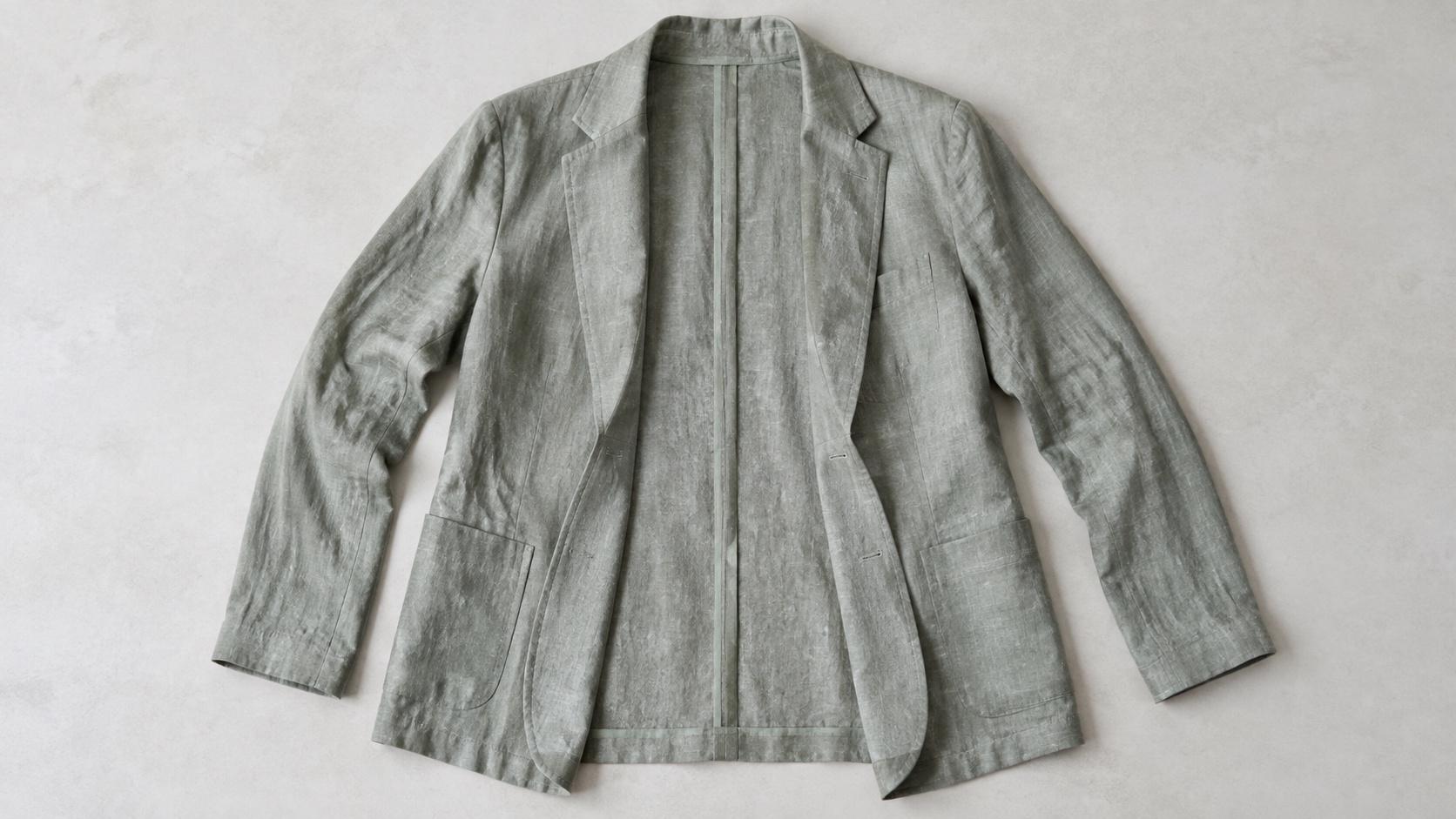
A summer linen jacket may be a relaxed resort layer, a soft office blazer or a more tailored occasion piece. These are different briefs. A buyer asking only for an “unlined linen blazer” leaves the manufacturer to guess the shoulder, chest support, sleeve lining and inside seam finish. Those guesses can change the feel and appearance as much as the outer cloth.
This guide helps independent menswear and resortwear brands turn that request into a sample-ready specification. For production requirements and an inquiry, use our private-label linen jackets and blazers programme. The construction options below are technical choices to discuss and approve, not a claim that every option is available for every project.
1. Unlined, half-lined and half-canvas: separate the two decisions
Lining coverage describes where the smooth inner fabric sits. An unlined body can still have front facings, a small upper-back lining or lined sleeves. A partially lined jacket covers selected areas. “Half-lined” is not a universally fixed layout: ask for a drawing showing the front, back, shoulders and sleeves.
Front structure describes the support between the outer cloth and the inside. Half-canvas construction generally uses canvas through the upper front and lapel, rather than the full length of the front. The lower front may still contain fusible support; confirm the actual method. “Unstructured” usually means reduced canvas and padding, not necessarily the absence of every reinforcing piece.
A jacket can therefore have an unlined back and a half-canvas front. Do not compare those labels as mutually exclusive alternatives. The distinction is illustrated in Permanent Style's guide to lining coverage and its example of an unlined-looking half-canvas jacket.
| Specification | What it controls | What to confirm on the sample |
|---|---|---|
| Unlined body | Lining coverage, not absence of all support | Exposed seams, facings, shirt friction and any sleeve lining |
| Partial or half lining | Selected areas covered by lining fabric | Exact front, back and sleeve coverage |
| Half-canvas front | Canvas support in the upper front and lapel | Canvas extent, attachment, lapel roll and any lower-front fusing |
| Unstructured front | Reduced canvas, padding and other support | Which supports remain; front drape and pocket stability |
Removing lining can improve ventilation, especially across the back, but it does not guarantee a cooler jacket. Cloth density, fit, canvas, facings and shoulder layers all contribute. Sleeve lining may help the jacket slide over a shirt; an unlined sleeve can catch and alter how it hangs. Full lining is not automatically unsuitable for summer.
2. Choose cloth by drape, opacity and stability—not GSM alone
GSM measures mass per area, not stiffness, airflow or resistance to seam slippage. Two linen fabrics with similar weights may hang differently because their yarn, weave and finishing differ. A very soft washed cloth can suit a relaxed layer but may need a different approach at the lapel and pocket than a crisp tailoring cloth.
Compare a medium-weight and a heavier candidate in hand rather than treating one weight range as a universal summer rule. The fabric library includes 230 GSM and 310 GSM linen examples; those numbers are comparison points, not a guarantee of jacket suitability or an instruction to use heavyweight cloth in hot weather. Use the linen GSM guide to shortlist cloth, then request a Sample Kit with your preferred silhouette and season.
- Hold the swatch to light: consider show-through at the front facing, pocket bag and seam allowance.
- Fold a mock lapel: does the cloth make the soft roll your reference requires, or collapse or spring outward?
- Sew and press a trial seam: inspect puckering, seam slippage and visible binding ridges.
- Confirm the finish: use the intended washed or unwashed cloth when approving support and care, not an unrelated swatch.
3. Stabilise selected edges without overbuilding the jacket
Linen's natural creases are not the same as a stretched neckline or an unstable pocket opening. Avoid a “wrinkle-free” promise; concentrate on retaining the intended dimensions and shape. Areas cut on a bias or repeatedly pulled during sewing and wear deserve particular attention.
- Roll line and front edge: discuss stay tape or other local support where required. It must not pull the front short or make the lapel rigid.
- Shoulder and armhole: assess reinforcement alongside sleeve pitch and fit. An armhole restriction is not solved simply by adding more tape.
- Pocket openings: check support and bartack placement with the actual pocket design; excess reinforcement may show through a light fabric.
- Collar: specify the undercollar and support appropriate to the silhouette. Felt or melton is an option in some tailored constructions, not a universal requirement.
For fusible components, confirm compatibility with the chosen linen and the intended care method. Adhesive, pressing conditions and differential shrinkage can affect bubbling or visible marks. For canvas, confirm composition and placement rather than assuming that the term always means an all-natural fibre blend. Inspect the pressed sample after it has cooled and rested.
4. Make the visible interior part of the specification
An unlined jacket exposes its workmanship. A tidy external silhouette is not enough if the inside has loose threads, abrasive edges or bulky bindings. Specify seam finishes by location, including the side seam, centre back, armhole, sleeve and hem.
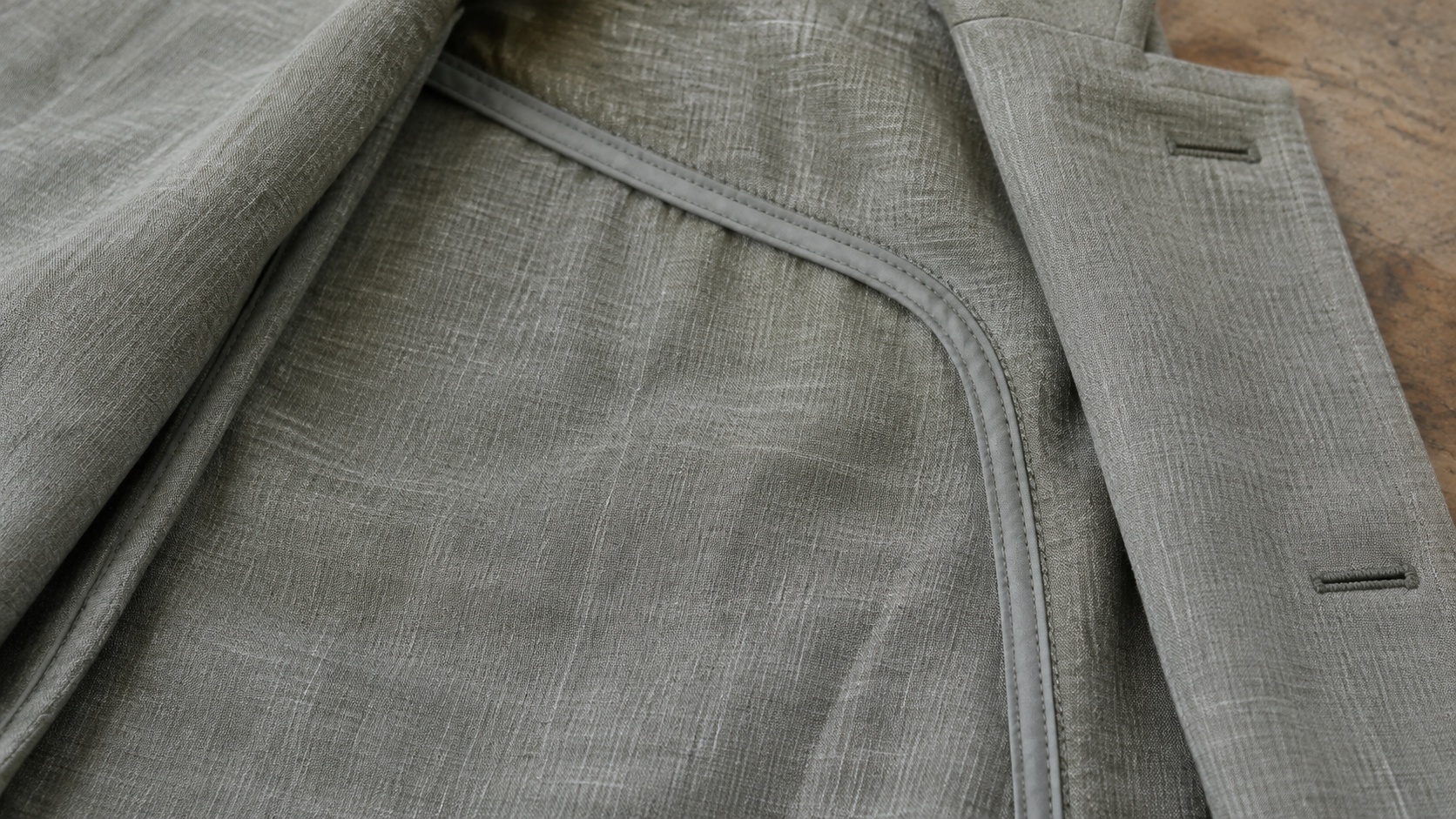
Hong Kong finish: a bias strip wraps the raw edge of a seam allowance and is secured neatly. Other bound finishes: folded binding or another enclosing method may suit a different edge. Specify the result and approve a physical example; terminology alone does not establish quality.
An appropriate overlocked finish can be acceptable for a more casual brief. Enclosed or felled seams may suit selected straight areas, but can add bulk on curved seams or heavier linen. Do not require French seams everywhere in a tailored blazer. Ask for binding that is soft against the wearer and compatible with the shell's care process, and check that it does not draw the seam tight.
Also inspect the hem and vent: they should lie flat without pulling or visible stitching that conflicts with the design. Hand finishing is not inherently required; the approved appearance and performance matter more than a vague “premium finish” label.
5. Fit and care-test the complete sample
Check the jacket over the type of shirt the customer will wear. Record chest, shoulder, sleeve, back length and other finished measurements with tolerances. Test reaching forward, sitting and closing the jacket. Pulling at the button, restricted upper arms or a collar gap may indicate a fit problem, not insufficient canvas.
Do not assume an unlined linen blazer is machine washable. The shell, canvas, fusible interlining, binding, labels and trims may shrink or react differently. If washable tailoring is part of the brief, validate the complete finished garment through the proposed care cycle before approval. A fabric-only shrinkage test cannot establish that the assembled blazer is washable. Our linen shrinkage guide explains why test conditions belong in the brief.
Photograph and measure the sample before and after the agreed care test. Inspect lapel roll, front bubbling, hem twist, binding tension and pocket openings as well as overall measurements. Follow the resulting care label; where professional cleaning is required, do not replace it with generic linen washing advice.
6. A sample-ready summer jacket checklist
- Reference and silhouette: relaxed or tailored fit, lapel shape, pockets, vents and shoulder appearance.
- Fabric: composition, candidate GSM, colour, weave, finish and approved swatch.
- Lining map: exact front, back and sleeve coverage, with lining composition and colour.
- Front structure: canvas or fusible support, its extent, attachment and any remaining padding.
- Interior workmanship: seam-by-seam finishes, binding, facing edges, hems and pocket support.
- Fit and care: measurement points, tolerances, movement checks and complete-garment test method.
- Approval record: inside and outside photographs, revision notes and an agreed reference sample before bulk.
Use our linen apparel tech pack checklist to document these decisions. For a coordinated summer range, the men's linen shirts and relaxed trousers guide covers the separate fit, wash and trim decisions for those garments.
Discuss your small-batch linen jacket
LinenTailor operates a cut-and-sew workshop in Dongguan, China, with fabrics sourced from trusted linen mills. Private-label and OEM linen jackets start at 30 pieces per colour, with sizes mixed freely within that colour. The minimum applies to each style and colour. OEKO-TEX Standard 100 certified fabrics and organic cotton certified fabrics are available on request at the fabric level.
Send your reference, fabric preference, lining map, desired front structure and quantities through the linen jackets manufacturer enquiry page. Specific canvas constructions, seam finishes and care claims must be reviewed for feasibility and approved on the sample. Send a usable sketch, tech pack or reference photo for your jacket project and LinenTailor will provide a human-reviewed quote within 24 hours after receiving usable inputs. When the same style's bulk orders accumulate to 150 pieces, the sample fee is refunded as a credit/deduction toward that style. Different styles are not combined toward this threshold.
For fabric selection, request a Sample Kit. For a project discussion, get a quote on WhatsApp. Orders use worldwide express shipping.
Frequently asked questions
- Is an unlined linen blazer the same as a half-canvas blazer?
No. Unlined describes the coverage of the interior lining; half-canvas describes the supporting construction inside the upper front and lapel. A blazer can combine an unlined back with a half-canvas front. Ask for a separate lining map and front-construction specification.
- Is half-lined the same as half-canvas?
No. Half-lined means only part of the inside is covered by lining fabric. Half-canvas means a canvas layer supports part of the jacket front. Neither term tells you the other specification, and manufacturers may use different lining layouts.
- Does an unlined linen jacket need finished internal seams?
Yes. Specify how every exposed seam allowance is secured. Options include bias-bound or Hong Kong finishes, selected enclosed seams, or a neat overlocked finish where appropriate. Approve the actual seam sample for fraying, bulk, puckering and comfort rather than assuming one finish suits every seam.
- Can a tailored linen blazer be machine washed?
Do not assume so because the outer fabric is linen or the back is unlined. Canvas, fusible interlining, binding, shoulder supports and trims can respond differently to water and heat. Follow the approved care label; a washable design must be tested as a complete garment before bulk approval.
- What is the minimum order for private-label linen jackets?
Private-label and OEM linen jackets start at 30 pieces per colour, with sizes mixed freely within that colour. The minimum applies to each style and colour.
- How quickly can I get a jacket quote?
Send a usable sketch, tech pack or reference photo for your jacket project and LinenTailor will provide a human-reviewed quote within 24 hours after receiving usable inputs.
- How is the jacket sample fee credited?
When the same style's bulk orders accumulate to 150 pieces, the sample fee is refunded as a credit/deduction toward that style. Different styles are not combined toward this threshold.
Further reading
- Permanent Style: defining unstructured jackets—background on reduced structure and remaining sleeve or upper-back lining.
Technical examples are selection guidance, not independent certification, performance guarantees or a statement that a specific construction has already been produced by LinenTailor.