September 9, 2026 · 12 min read
Why AI Fashion Renders Don't Match the Real Sample — and How to Close the Gap
AI design tools produce beautiful garment renders that factories cannot reproduce one-to-one. Here are the seven technical reasons the first sample looks different, and a practical workflow independent designers can use to turn an AI image into a manufacturable linen garment.
Key takeaways
- AI renders describe how a garment looks, not how it is built — no fabric weight, grainline, seam allowance or shrinkage is encoded in the image.
- The five biggest mismatch sources are fabric drape, colour, texture scale, construction feasibility and body proportion.
- Linen exaggerates the gap: it is heavier, crisper and shrinks 3–7%, so an AI render styled on silky drape will never match a real linen sample.
- Fix the gap before sampling: convert the render into a tech pack, choose a real fabric by GSM and weave, and approve physical swatches and lab dips.
- Budget one intentional revision round. A first sample that is 80% right is a normal, healthy result — not a factory failure.
- LinenTailor samples and produces apparel from 30 pieces per colour, and home textiles from 1 piece, so AI-led capsules can be tested at small scale.
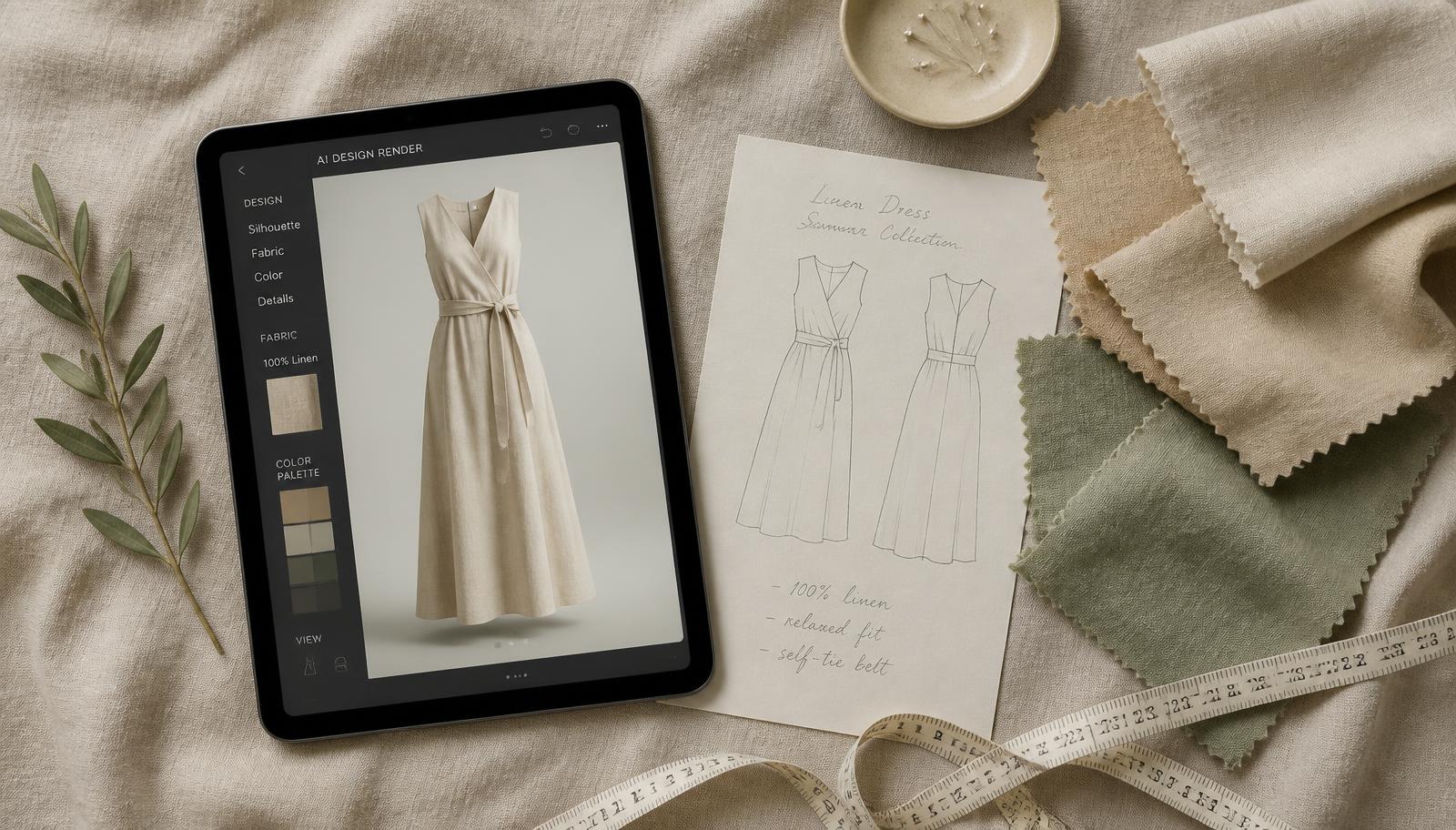
AI design tools have changed how independent brands start a collection. A designer can move from idea to a convincing garment image in an afternoon. Then the sample arrives — and it is not the same garment. The neckline sits differently, the fabric stands away from the body instead of pooling, the colour reads greener, and the whole thing feels heavier than the picture promised.
This is not a factory failure, and it is not a failure of your creativity. It is a translation problem. An AI render describes appearance; a garment is built from specification. This article explains exactly where the two diverge, and gives you a workflow we use with designers at our Dongguan workshop to close the gap in one sampling round instead of four.
The core problem: an image carries none of the data a pattern needs
To sew a garment, a pattern maker needs roughly a dozen facts. An AI image supplies none of them:
| What the factory needs | Is it in the AI render? |
|---|---|
| Fibre content and blend ratio | No — implied at best |
| Fabric weight (GSM) and weave | No |
| Finish (enzyme wash, stonewash, garment dye) | No |
| Measurement chart in a base size | No |
| Grainline and cutting direction | No |
| Seam allowance and seam type | No |
| Shrinkage allowance | No |
| Trims, closures, labels | Visual guess only |
| Colour standard (Pantone TCX) | Screen colour only |
When those fields are blank, the factory fills them in from experience. The first sample is therefore an honest reflection of their assumptions, not your intent.
Seven reasons the sample looks different
1. Drape physics the fabric cannot perform
Image models are trained overwhelmingly on photographs of fluid fabrics — silk, viscose, fine jersey. They will happily render "100% linen" with liquid folds that linen physically cannot make. Linen at 160–260 GSM holds structure, breaks into angular folds and stands slightly away from the body. If your render shows clinging softness, you are looking at a silk simulation with a linen label.
2. Colour behaves differently on fibre than on screen
A screen emits light; fabric reflects it off a textured, uneven surface. Natural linen fibre also has a warm greige base, so the same dye recipe reads warmer on linen than on cotton. A sage that glows on your monitor typically lands one or two steps duller and greyer in cloth. This is normal and it is why lab dips exist.
3. Texture scale is invented
AI renders often show a slub or weave texture at a scale that does not exist at any real yarn count — either far too coarse (looks like hessian) or too fine (looks like cotton poplin). Real texture is decided by yarn count, weave and finishing, not by the picture.
4. Construction details that cannot be sewn
Common impossibilities we see weekly: seams that vanish mid-panel, a collar with no visible attachment, pockets floating without a seam to hang from, a placket that changes width, sleeves with two different cap heights. A pattern maker must resolve every one of these, and each resolution is a small design decision made by someone other than you.
5. Body proportion is not a size chart
Renders are usually posed on idealised, elongated figures. A hem that reads mid-calf on a nine-head figure lands below the knee on a real 165 cm body. Without a measurement chart, proportion is the single most common surprise in a first sample.
6. Shrinkage and finishing were never accounted for
Linen shrinks roughly 3–7% depending on weave and finish. A garment cut to the render's proportions and then washed will come back shorter and narrower than the picture. Good factories add shrinkage allowance at the pattern stage — but they need to know your intended wash.
7. Lighting hides everything a garment is judged on
Renders are lit like campaign photography: rim light, soft shadow, no wrinkles. Linen creases as a property of the fibre. A real sample photographed under office light will always look less resolved than a render, even when it is exactly right.
The workflow that closes the gap
Step 1 — Treat the render as a mood reference, not a spec
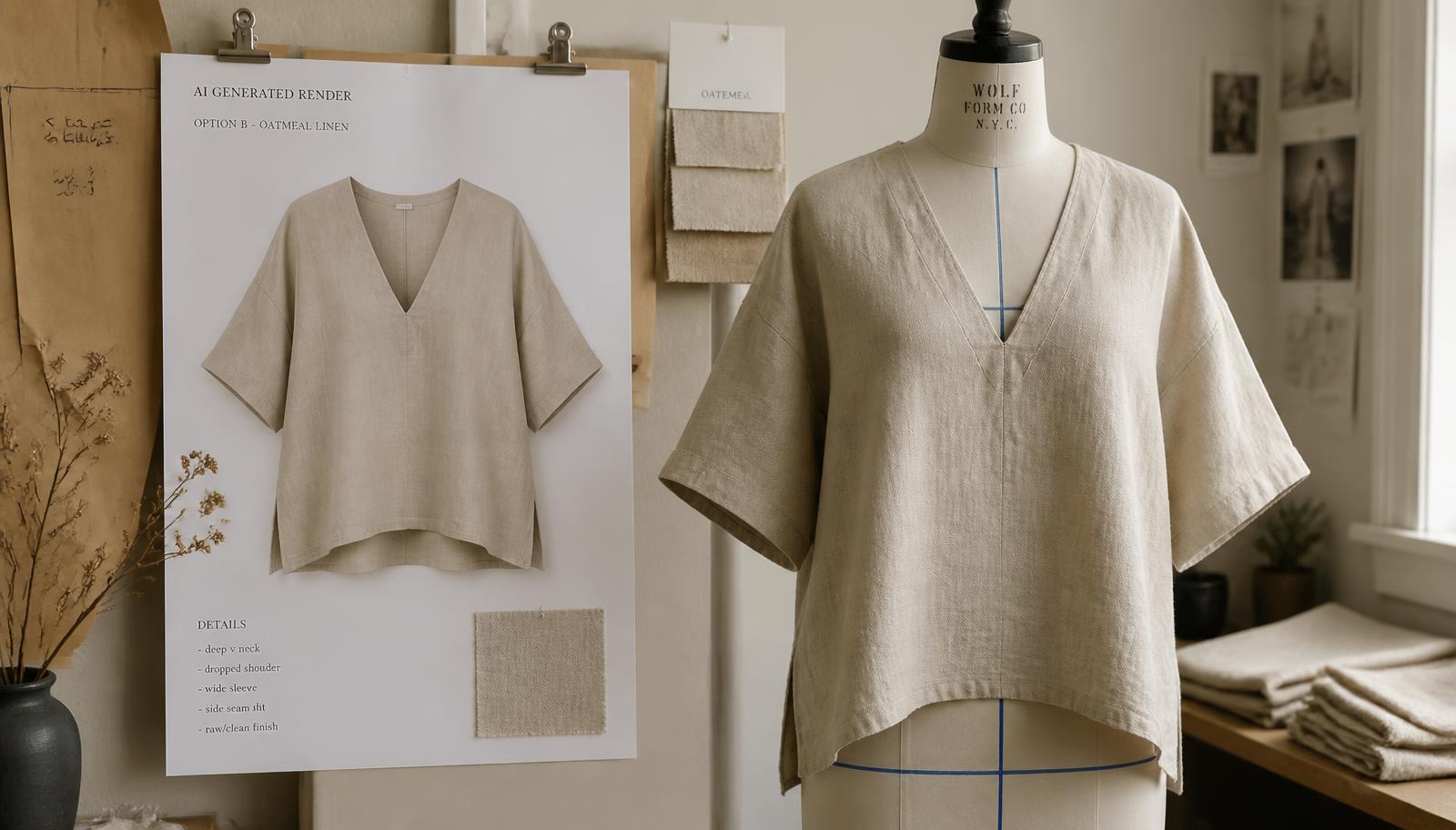
Decide up front which three things in the image are non-negotiable: usually silhouette, one construction detail, and colour family. Everything else is open for the factory to optimise. Designers who declare their priorities get much closer samples than those who ask for "exactly this".
Step 2 — Choose a real fabric before you finalise the shape
Fabric decides silhouette, not the other way round. Pick the fibre, GSM, weave and finish first, then adjust the design to what that cloth can do. A structured shirt-dress wants 180–220 GSM; a fluid summer slip wants a lighter, softer washed quality. Our linen GSM chart and weights and weaves guide map weights to garment types.
Step 3 — Let AI do the part it is genuinely good at: matching fabric
Image generation is weak at physics but strong at pattern recognition. Upload your render to AI Fabric Match and it will recommend linens and blends from our stocked library — GSM, weave and construction — that can actually produce the look you drew. This is the single highest-leverage step in the whole process.
Step 4 — Hold the real cloth before you sample
Order swatches from the fabric library and drape them over your hand, over a chair, over a dress form. Ten minutes with physical cloth eliminates more sampling rounds than any amount of prompt engineering.
Step 5 — Convert the render into a minimum viable tech pack
You do not need professional CAD. A workable pack is: a flat front and back sketch, a measurement chart in one base size, fibre + GSM + weave + finish, trims list, colour reference (Pantone TCX where possible), and a reference garment you own whose fit you like. Our sampling process and cost guide shows what happens to each of those fields in the workshop.
Step 6 — Plan two rounds and give feedback in measurements
Round one validates silhouette, fabric behaviour and fit. Round two locks proportions and finishing. When you give feedback, convert impressions into numbers: not "the sleeve looks off" but "shorten sleeve 3 cm, reduce cap height 1 cm, widen hem 2 cm". Numeric feedback is the difference between two rounds and five.
Step 7 — Approve colour on cloth, never on screen
Ask for lab dips, view them in daylight, and approve a physical standard. Accept a small tolerance; every brand in the industry works this way.
What this means for a small independent brand
The economics matter as much as the technique. If your minimum order is 300 pieces, an AI-led design that lands 80% right is a serious financial problem. If your minimum is 30 pieces per colour, it is a first edition you can sell, learn from and refine next season. That is why we publish a real 30-piece-per-colour minimum for custom linen apparel, and a one-piece minimum for linen home textiles — AI-assisted design only works commercially when the batch size lets you iterate.
A realistic expectation to set with yourself
The goal is not a sample identical to the render. The render was never a physical object. The goal is a garment that carries the same idea, in a fabric that can actually hold it, at a quality your customer will pay for. Designers who start from that framing get to production one or two rounds faster than those chasing pixel fidelity — and their finished garments almost always look better than the image that started them.
Have an AI-generated design you want to make? Send the image plus your target price and quantity — we will tell you within 24 hours which linen can carry it, what needs to change to be sewable, and what sampling will cost.